Army
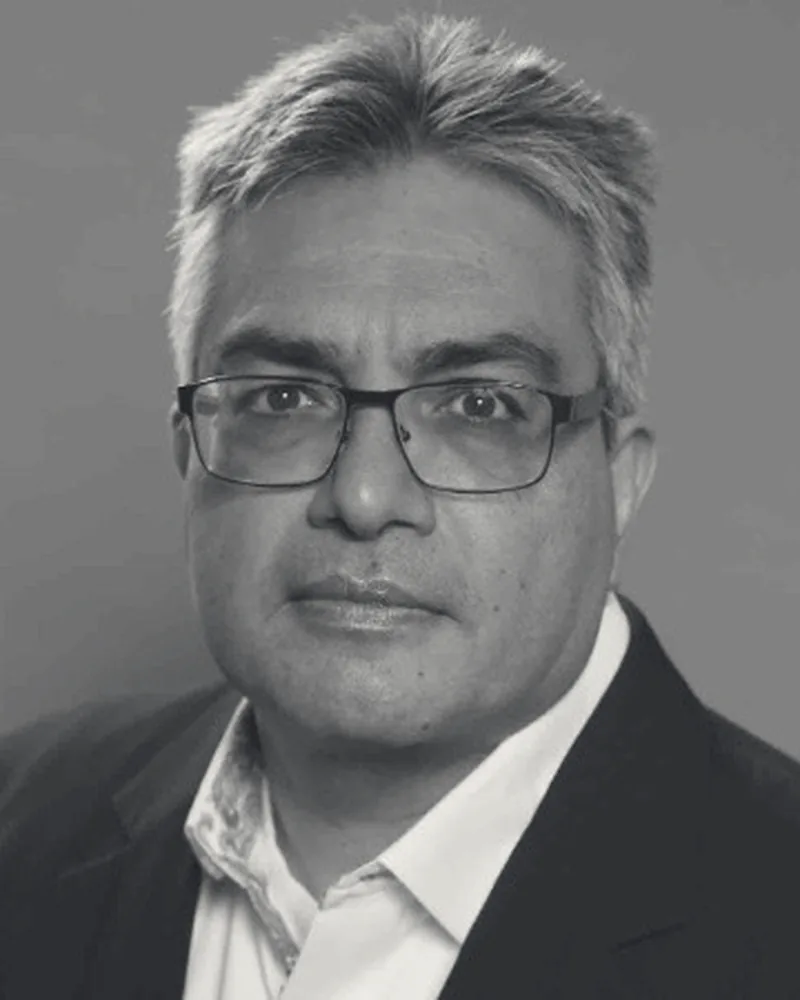
Karim Jaffer
- Generation
- First Generation
- Branch
- Army
Before
Karim Jaffer enlisted in 1984, and the Army made him a combat medic.
The Army he joined had spent four decades preparing for a war in Europe, and its medical branch trained the medics who would go forward with the divisions. The force of 1984 was eleven years into the all-volunteer model, and it was growing. The build-up of that decade added divisions, and the recruiting commands that filled them were selling training and a trade rather than a draft notice. A combat medic was one of the trades on offer: a 91-series course at Fort Sam Houston, then a posting to a line battalion.
Service
A combat medic was not a doctor and was not trained to be one. The job was the first ten minutes of a casualty's care: the pressure dressing, the airway, the tourniquet, and the move to the next level. The medic carried the aid bag, and what was in it was what a wounded Soldier got before the hospital.
The Army's 91-series medics trained at Fort Sam Houston, in San Antonio. The field included medics, practical nurses, and technicians, and the combat medic was the job closest to the line. The 91B course covered the field care of wounds, and the 91C track added the ward work of a practical nurse. A combat medic in a line battalion worked for a physician assistant or a battalion surgeon. The job could be in a battalion aid station, a clearing station, or a hospital behind the lines.
He held the job for seven years, from 1984 to 1991.
His seven years ran through the end of the Cold War. The Army of the 1980s kept divisions in Germany and Korea and trained in the United States to reinforce them. The Berlin Wall came down in 1989, and he was discharged in 1991.
After
He left the Army in 1991 and went back to school. Radiology came first, at MedStar Georgetown — computed tomography, magnetic resonance imaging, radiography — then medical physics at Georgetown, then medical dosimetry at the University of Wisconsin-La Crosse. MedStar Georgetown is a hospital in Washington, DC.
He worked six years at Radiation Management Associates. He has been at Varian since 2008, and he has worked in dosimetry since 2002.
A medical dosimetrist turns a radiation oncologist's prescription into a plan: how many beams, from what angles, at what intensity, for how many fractions. The plan is built on a scan of the patient, and it has to account for the shape of the tumor, the tissue around it, and the way the beam moves through both. Radiation oncology is the specialty that treats cancer with radiation. The treatment is planned in advance so that healthy tissue gets as little of the dose as possible, and it is delivered in fractions over several weeks. A linear accelerator is the machine that delivers the beam. The tumor gets the dose. The heart, the spinal cord, the lung, and the eye do not.
He describes the job in one sentence: "a delicate balance between delivering the prescription the physician has written while ensuring the patient will not lose important healthy organ function."
At Varian he is a clinical applications specialist and a certified medical dosimetrist, and his job is to teach the machines and the software that deliver radiation therapy: Eclipse for treatment planning, Ethos for adaptive radiotherapy, Velocity for image fusion, ARIA for the oncology record, TrueBeam and Trilogy for delivery. The company is a manufacturer of radiotherapy equipment. He trains the physicists and the therapists who run them.
For a decade he taught at Howard University as an adjunct professor in allied health sciences, coaching radiation therapy students. The classes were blended and run through Moodle; he wrote the syllabi, set the tests, and graded against rubrics. The subjects were cross-sectional anatomy, physics, and radiation therapy problem-solving.
He also volunteers with Radiating Hope, a volunteer-run nonprofit that has placed radiation equipment in more than thirty countries. The line he keeps beside that work is from the Qur'an: whoever saves a single life, it is as if he saved all of humanity.
He kept adding degrees: a master's in education technology from Keller Graduate School of Management, a graduate certificate in healthcare compliance from Mitchell Hamline, and a master's in medical physics at Oregon State, finished in 2026 after three years.
He grows things at home — hydroponic beds, worms for compost, poultry — and he reads science fiction and cooks barbecue. His aim, in his own words, is "serving my Ismaili community, my loved ones, as well as the imaging profession with my knowledge, time, and means to the best of my ability."
Service record
- Branch
- Army
- Years
- 1984–1991
- Rate / MOS
- 91-series, Combat Medic
The Cold War Army, 1984–1991
In 1984 the Army was in the middle of the Reagan build-up and still organized around the defense of Western Europe. Its divisions trained in Germany, its hospitals planned for a European war, and the Cold War ended while the Soldiers who trained for it were still in uniform.