Marine Corps
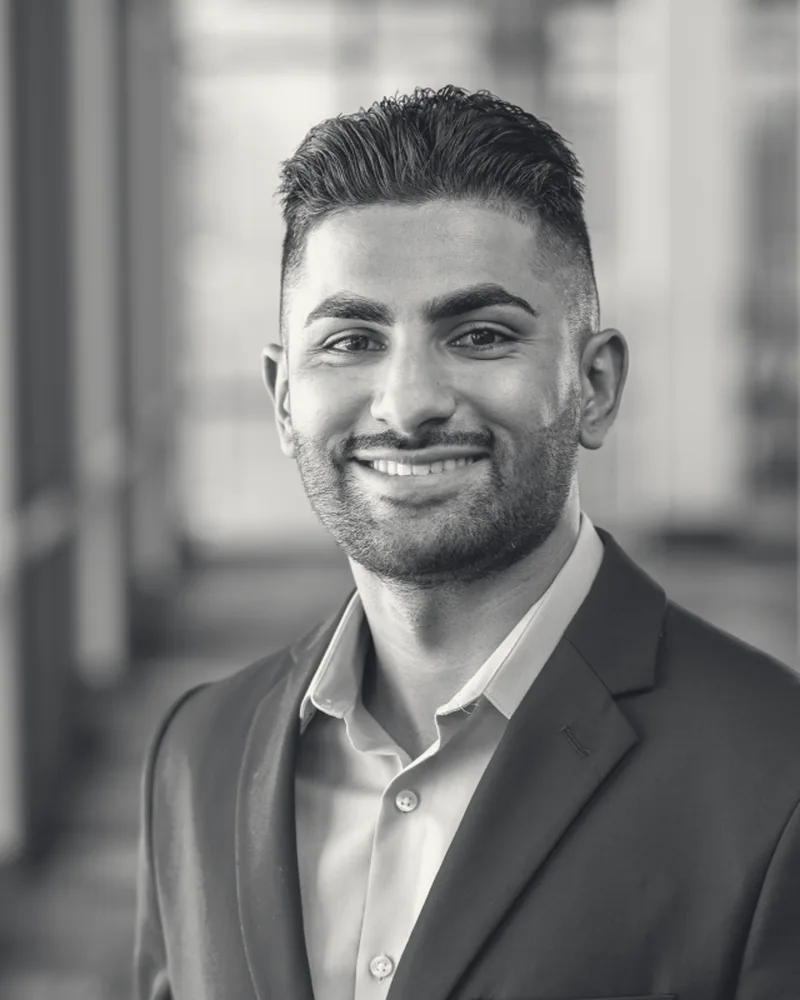
Zayn Dhanji
- Generation
- Fifth Generation
- Branch
- Marine Corps
Before
Zayn Dhanji split his childhood between Fort Lauderdale, Florida, and Birmingham, Alabama. He was a member of the Jamat in both cities.
In 2007, at the Golden Jubilee in Fort Lauderdale, a Marine taught a hall of Ismaili children to march. Zayn Dhanji was one of them. The Marine was Imran Kasam.
He went to Auburn University, in Alabama, and studied management information systems. He was a junior in 2019, three years into the degree, and nothing required him to go.
He called Amyn Porbanderwala, a Marine from the community, and asked whether the Marine Corps was worth it.
The answer was a warning and a promise. The Corps, Amyn said, strips a man down to the bare bones and builds him back, and it does not suit anyone who has had an easy life. But if he finished, nothing he did afterward would compare, and a brotherhood would be waiting.
He finished at Auburn in 2020, and that September he reported to Quantico, in the middle of the pandemic.
1stLt Travis Manion, killed in Fallujah in 2007, left a sentence behind: if not me, then who. In his account, Zayn Dhanji carried it into the Corps. He wanted the Americans he would serve with to see that the country was his too.
“I felt like I had to.”
Service
Officer Candidates School runs ten weeks at Quantico, Virginia, and it is the route to a commission for college graduates who did not come through the Naval Academy or a reserve officers' training program. He went through as Officer Candidates Class 235.
The Basic School runs six months, and every new officer attends it before his specialty school. The course is infantry: rifle squad tactics, then rifle platoon tactics, then the basics of commanding a Marine air-ground task force. Then he went to the Basic Communications Officer Course at Twentynine Palms, California, in the Mojave. A communications officer learns to lead a rifle platoon before he learns to run a radio net.
In January 2022 he joined 23rd Marine Regiment at San Bruno, California, as an assistant communications officer. The regiment is a Reserve infantry regiment, with units in eight states from California to Alabama.
The work was the shop's day to day: the radios, the cryptologic equipment, the training records, and the inventories that have to match.
He made first lieutenant in November 2022.
In July 2023 he went to Coveñas, Colombia, for UNITAS, the maritime exercise the United States has run with Latin American navies since 1959. Colombia hosted it that year, and twenty countries took part. The land side of the exercise ran out of Cartagena, Barranquilla and Coveñas. He was the communications officer for the Marine element.
In April 2024 he took over as communications officer of 2nd Battalion, 23rd Marines, in Pasadena, California. The battalion is an infantry battalion, and he was a first lieutenant when he took it.
He ran the battalion's communications shop. The platoon was about 85 Marines. The network they kept up served about 900 users across the formation.
The radios carry the orders, the network carries the data, and the cryptologic equipment keeps both from being read by anyone else. A communications officer's job is to keep the commander linked to every unit he cannot see. Every plan carries a PACE: primary, alternate, contingency, emergency. The first three can fail.
In his account, the Marines he led were a large part of how he kept his head above water at an infantry battalion.
“I had the Corps’ best and brightest in my section and I was proud to work alongside them every day.”
A Reserve communications officer has a civilian job the rest of the month, and the battalion's drills are the calendar around it.
On 1 November 2024 the battalion was activated for UDP 25.1. It was the battalion's first call-up in five years.
It spent the next six months at Twentynine Palms, the same base where he had learned the job, working up for the deployment.
Then it went to Okinawa, to support III Marine Expeditionary Force.
In July 2025, in Okinawa, he was promoted to captain.
In August the battalion went to South Korea for the Korean Marine Exercise Program, and he went with it. The capstone was an amphibious assault at Pohang, on the southeast coast, alongside South Korean marines. They took a beachhead on the sand and a simulated helicopter landing zone on the hill behind it, and a thunderstorm grounded the helicopters.
He came home in the fall of 2025 and separated in December. He had served five years and four months.
After
Boeing hired him in Dallas in October 2023, while he was still drilling, as a procurement analyst. The job was the government purchase orders that aircraft programs run on, more than 1,500 of them.
Then the battalion was activated, and he left the job for a year on active duty.
He came back to Boeing in the fall of 2025. In January 2026 he moved into supply chain order management. The work became the life cycle of defense components: the parts that have to be on the line before an aircraft can be finished. When one of them is late, the schedule slips.
His job is the parts that are late. He finds out which one is holding up an aircraft, who can fix it, and how long it will take, and he tells the engineers and the program managers what he knows.
Before Boeing he worked in operations analytics at Snap One and at United Airlines.
He lives in Grapevine, Texas, between Dallas and Fort Worth. He is among the public founding members of the Ismaili Warrior Alliance.
In 2007 a Marine taught a hall of children in Fort Lauderdale to march. One of them went to Auburn, picked up the phone in 2019, and finished as a captain. There is another hall, and another child in it.
Service record
- Branch
- Marine Corps
- Years
- 2020–2025
- Rate / MOS
- Communications Officer (0602)
- Rank at separation
- Captain
- Units
- 23rd Marine Regiment · 2022–2024
- 2nd Battalion, 23rd Marines · 2024–2025
The Unit Deployment Program
The Marine Corps keeps its force in the Indo-Pacific by rotating units in rather than stationing them there permanently. Under the Unit Deployment Program a battalion goes forward for about six months. For a Reserve battalion the year starts earlier, with a workup in the United States: 2nd Battalion, 23rd Marines was activated on 1 November 2024, spent six months at Twentynine Palms, and then deployed to Okinawa to support III Marine Expeditionary Force.
The Communications Officer
Communications is the Marine Corps' 06 occupational field. Its officers are responsible for the planning, installation, operation, displacement and maintenance of the network, transmission and data systems a command fights on. A battalion's communications officer runs its communications shop: the radios, the data links, the cryptologic equipment, and the Marines who keep them working.
The Basic School
Every service trains its officers for the job they will do. The Army, the Navy and the Air Force send a new officer from commissioning into training for his branch or designator. The Marine Corps puts the infantry course first and the specialty school after it. The lawyer, the pilot and the communications officer all go through it.