Marine Corps
The Marine Corps is the naval infantry of the United States, organized under the Department of the Navy and smaller than the Army, the Navy and the Air Force. It keeps its own recruit depots at Parris Island and San Diego, its own officer candidate school at Quantico, and a rule that every Marine, whatever the specialty, trains as a rifleman before going to a technical school.
Every service trains its officers for the job they will do. The Army, the Navy and the Air Force send a new officer from commissioning into training for his branch or designator. The Marine Corps puts the infantry course first and the specialty school after it. The lawyer, the pilot and the communications officer all go through it.
In the record’s first generation, 1977 to 1989, the Corps was an all-volunteer force finding its footing after Vietnam. It took on new aircraft, kept a landing force afloat in the Mediterranean, and put Marines ashore in Beirut in 1982 and Grenada in 1983. An enlisted Marine of those years could expect recruit training, then a specialty school, then a squadron or a battalion. A Marine aircraft group is built around squadrons, and each squadron’s shops — airframes, power plants, avionics, ordnance — own their own systems and sign their own repairs.
The intelligence and signals work is older than the networks it now runs on. An S2 is the intelligence section of a Marine staff; its estimate covers terrain, weather, order of battle and the ground a unit will cross, and it produces the map, the overlay and the briefing that a commander plans against. In the 1980s that work was done on paper and acetate, on a map board. By the 2000s the same section was tied to radios, cryptologic equipment and data networks, and the communications shop that kept those running had become a specialty of its own.
Part of the Corps’ service is Reserve service. The Marine Corps Reserve is not a separate corps: it keeps a division and an aircraft wing, and its infantry battalions drill one weekend a month and two weeks in the summer, under the same standards as the active force. A Reserve battalion can be mobilized, and after 2001 the Reserve was used as an operational part of the Corps rather than as a force held back for a major war.
The years after 2001 took the Corps into Iraq and Afghanistan and kept it there for a decade. Then came a smaller force, a return to the Pacific, and the Unit Deployment Program’s six-month rotations to Japan. Communications, intelligence and aviation kept growing in importance as the infantry’s work became more dependent on the network that connected it. The difference between a 1977 enlistment and a 2020 commission is the difference between a Cold War corps and one organized around deployments: the 2020 commission follows a ten-week officer candidate course, a six-month basic course and a specialty school before it reaches a battalion.
The published record
Every published member who served in the Marine Corps, grouped by the generation in which their service began. A member who served in more than one branch appears on each branch’s page.
First Generation

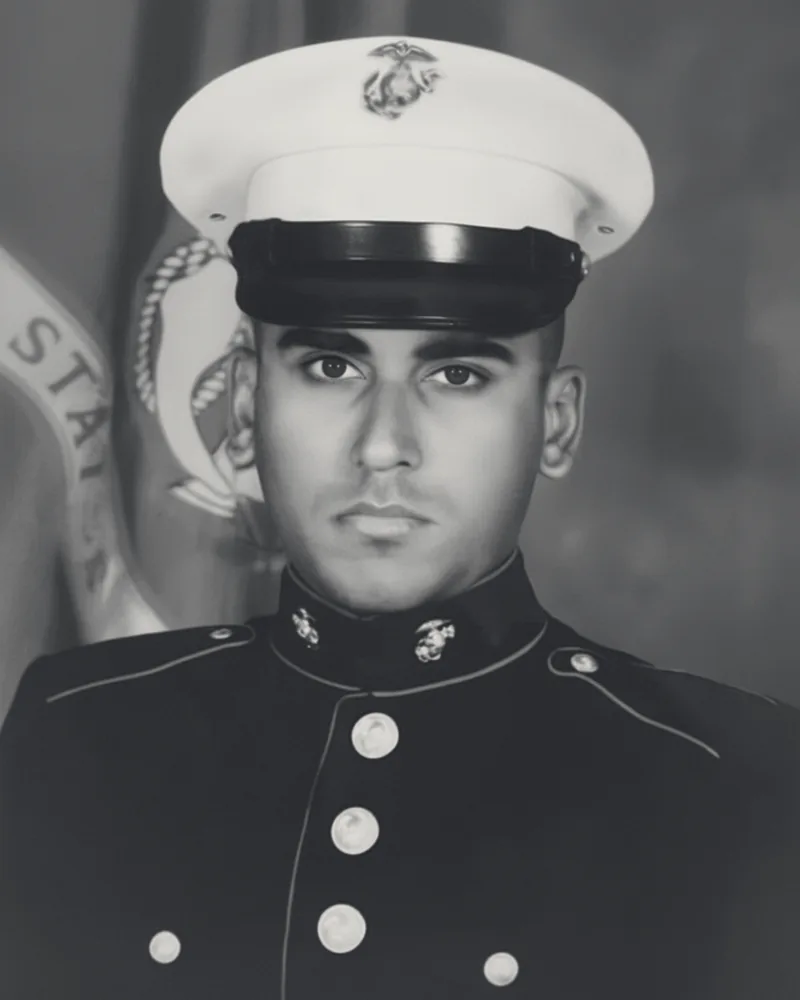
2 published portraits
Second Generation
No published profile in this generation.
Third Generation

1 published portrait
Fourth Generation

1 published portrait
Fifth Generation

1 published portrait
How to read the dates
- start withheld
- approximate
- service continuing