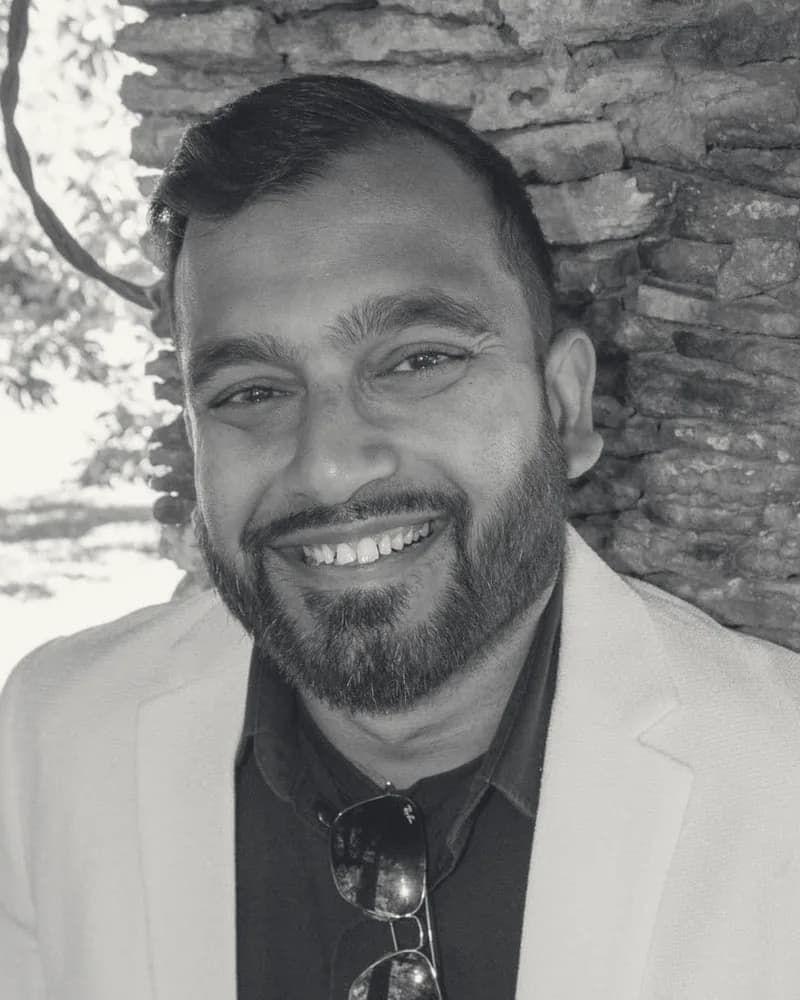
Army
Ayaz Parbtani
- Generation
- Third Generation
- Branch
- Army
Before
Ayaz Parbtani enlisted in the Army in June 2006, from a job repairing computers at Florida International University in Miami.
He had worked at the university since 2002, first as a computer associate in university technology services, then as a computer repair and safety technician. The work was on a bench: a machine that would not start, a cable that did not carry, an intermittent fault somewhere in a chain of parts that had to be found before anything could be repaired.
The sequence was the same every time: find the fault, fix it, and run the machine again to see whether the fix held. He had been at the university for four years, and he was still there when he enlisted.
Service
He went into Army aviation. His specialty was avionics communications equipment repair: the flight instruments, the radios, and the electronic interfaces a pilot uses to navigate, to coordinate, and to talk. The work was not the engine and not the airframe. It was the part of the aircraft that connects it to everything outside it.
The aircraft were rotary-wing, and the work was diagnosis. A fault in a wiring harness does not announce itself, and a radio that fails intermittently will pass a test that is run once. Avionics work is the management of small failures: a connector that corrodes, a wire that chafes against a bulkhead, a set that works on the bench and not in the aircraft. The systems had no tolerance for a guess.
The work ran in cycles. A discrepancy was written up, a troubleshooting sequence was run in order, the faulty part was replaced, and the system was tested again. The repair ended when the test passed and someone signed for it.
Before Germany he had gone through the Army's schools for aviation electronics and avionics. The schoolwork was the bench work against a written standard: wiring diagrams, test equipment, and a procedure for what counted as fixed.
He was stationed in Germany, at Illesheim, an aviation post in Bavaria with an airfield and a maintenance mission. The training he did in Germany was an off-site at Katterbach, the brigade's headquarters near Ansbach, a short drive away.
He arrived at Illesheim in the middle of a turnover. The battalion that had held the post for nineteen years had cased its colors the summer before, and the aviation brigade that replaced it was still being assembled around him.
In 2007 that brigade deployed to Iraq for fifteen months. It served there as Task Force XII, most of it working from Balad, and the pace was set by the aircraft. The brigade logged more than eleven thousand flight hours in its first three months. A pilot in one of its companies said most of them would do about five years of flying in fifteen months. The aircraft came back, were fixed, and went out again.
In his own account, the lesson of those years was to check, to double-check, and to check again.
In July 2010 he cross-trained as a Security Communication Specialist, and he worked the specialty until he separated. Avionics is the aircraft's own network. Security communications is the network a command travels on, and the second has to work and stay closed to anyone the Army has not authorized. Encryption is what makes a message readable at one end of a link and not at the other. The equipment was different: encrypted systems, secure links, and the procedures that go with them.
That specialty went to Afghanistan. He deployed for twelve months in 2010 and 2011, his second tour, and the work was the other half of the same idea: not the aircraft's own systems but the link a unit depends on, kept open to the people cleared to use it and shut to everyone else.
He separated in June 2012, after six years in aviation and signals and two deployments.
After
He went into testing. VAM USA hired him as a research technician in 2012, and for two years he tested joints and connections for structural integrity, on industrial applications.
He spent the next five years at Advanced Cellular Trading in South Florida, first as purchase manager and then as quality assurance manager, building sourcing operations and quality systems for international clients. The purchasing came first: sourcing the devices the company would resell.
In 2019 he joined Reliance Trading LLC in Hollywood, Florida, as senior quality assurance manager. The company trades new and refurbished consumer electronics. He leads a team of certified technicians, and the phones, laptops, and tablets that leave the facility have been through his inspection.
He joined the Ismaili Warrior Alliance in October 2025, and he is among its public founding members.
He lives in South Florida.
Service record
- Branch
- Army
- Years
- 2006–2012
- Rate / MOS
- Avionics Communications Equipment Repairer / Security Communication Specialist
- Rank at separation
- Specialist
Illesheim
Illesheim is a village in Bavaria, in southern Germany, and the Army's post there, Storck Barracks, has an airfield attached to it. For nineteen years it was home to 7th Battalion, 159th Aviation Regiment, an aviation maintenance unit. The battalion cased its colors at Storck Barracks in July 2006, and its soldiers were reassigned into the 12th Combat Aviation Brigade, which was forming at Illesheim and at Katterbach, the brigade's headquarters near Ansbach.
Task Force XII
The 12th Combat Aviation Brigade deployed to Iraq in 2007 for fifteen months and served there as Task Force XII, the aviation asset for the corps command in the country. Most of the brigade worked from Logistics Support Area Anaconda at Balad. It was the only aviation brigade in Iraq covering the whole country rather than one division's area, and in its first three months of flying it logged 11,513 flight hours on 1,738 missions.