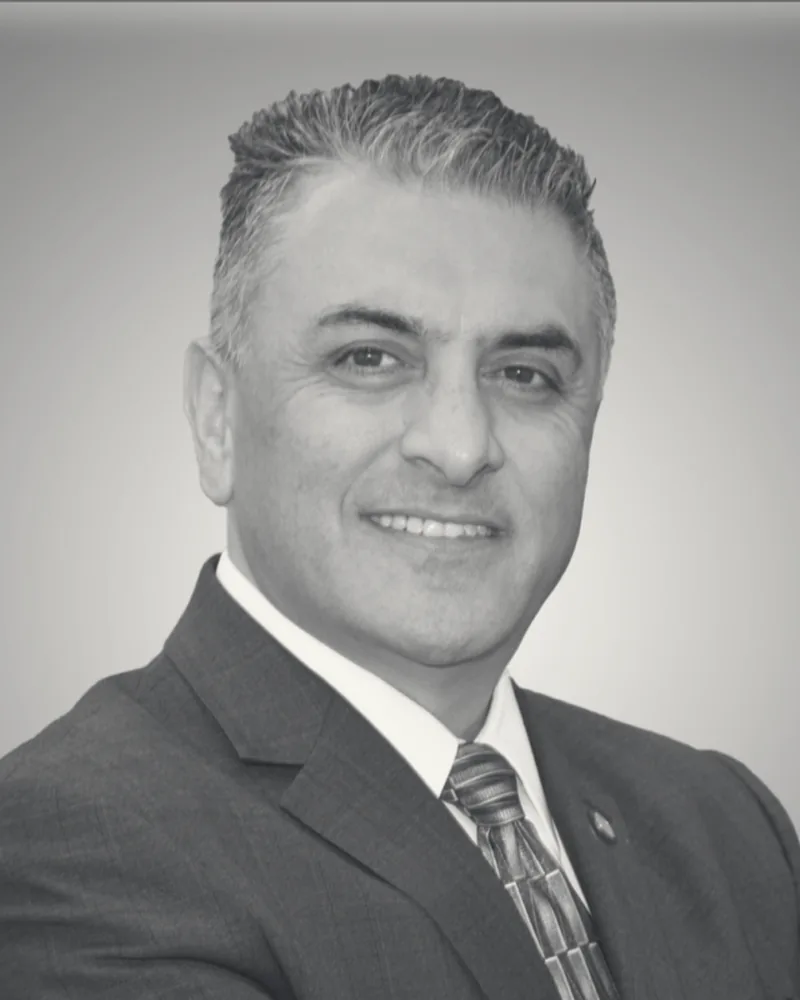
Navy
Salim Rahemtulla
- Generation
- Second Generation
- Branch
- Navy
Before
Salim Rahemtulla was commissioned an ensign in the Navy in May 1990, out of the Naval Reserve Officers Training Corps at the University of Southern California. The program commissions officers from civilian universities into the Navy. He finished a bachelor's degree at USC in the same spring.
The Navy he joined had been built against the Soviet fleet. The Berlin Wall had come down in November 1989, the Warsaw Pact was dissolving, and the service was beginning to plan for a smaller force. The fleet began the decade with more than 500 ships. It ended the decade with fewer than 320. An ensign reporting in the spring of 1990 entered an institution that had spent four decades preparing for a war that was ending.
Service
His first assignment was Dam Neck, Virginia, at the Navy Marine Corps Intelligence Training Center. The center is where the Navy and the Marine Corps train intelligence officers, and the course came before his first ship.
He went next to Coronado, California, for the Naval Surface Warfare Officer School in 1991. The school is where the Navy trains the officers who stand watch on and fight a surface ship, and the course ran before he reported aboard his first command.
From there he joined USS Durham (LKA-114), an attack cargo ship. He deployed to the Western Pacific with a five-ship Amphibious Ready Group and Marine Service Support Group 13 out of Camp Pendleton. The group trained for amphibious operations and kept a landing force ready to go ashore.
Aboard Durham he was first the gunnery officer, responsible for the ship's weapons and for the sailors who worked them. He was later the administrative and legal officer — the ship's paperwork, and its legal work. Durham carried what a landing force needed, and the cargo holds were the reason the group could stay at sea. The navigator's job was the one after. The ship did not last long enough for it to be his.
In 1994 he decommissioned the Durham. The ship had been in commission since 1969 and had served in the Gulf War.
He finished his active duty at Naval Air Station Miramar and moved to the civilian side of the same base, working the conversion to Marine Corps Air Station Miramar through 1999. The program ran to billions of dollars and moved thousands of personnel. The work was master planning, environmental compliance, community relations, and the transfer of the station. The Marines moved in from El Toro during those years.
He did four years of active duty and six in the Individual Ready Reserve, and he left the Reserve in 2000 as a lieutenant.
After
Banking came next: Union Bank of California, then KeyBank. Military housing development followed at Clark Realty Group and American Eagle Communities, then luxury residential at Standard Pacific Homes and Watermarke Properties. The housing question was the one he kept meeting. When a sailor transferring from Chicago to San Diego needed help finding a home near the base, Salim answered. In 2001 he finished a master's degree in business administration at USC's Marshall School of Business.
In 2009 he returned to federal service at Naval Facilities Engineering Command — renamed Naval Facilities Engineering Systems Command in 2020 — in Ventura County, as the senior community facilities planner and community liaison officer for the base. In 2011 he moved to the command's Seal Beach office, where he managed a facilities portfolio worth more than $1.5 billion. He was at the command for twelve years, one of seventeen he spent as a federal civilian across the Marine Corps, the Department of Housing and Urban Development, and the Navy.
Alongside that work he built his own practice. Urban Core Realty Advisors, which he has run since 2009, develops real estate and renewable energy for landowners. FOTON Technologies was a twelve-year renewable energy development role. Between the two he has managed more than thirty projects worth over $1 billion and maintains a 95 percent entitlement approval rate.
From 2013 to 2020 he was project development manager for the renovation of an Ismaili community center for the Aga Khan Council for the Western USA. It is the same work he had done on a naval air station, applied to his own community.
In 2021 he took the chair of the Mobility Initiatives Committee of the California Hydrogen Business Council, and a seat on the council's board. He held both until the fall of 2024. The committee works the policy side of hydrogen: the rules and the programs that let hydrogen vehicles and fueling stations be built.
He had joined PowerTap Hydrogen Fueling Corp. as president at the beginning of 2021, and at the beginning of 2023 he became its chief executive officer. The company, now NexxGenn Power Corp., builds on-site hydrogen production and fueling equipment, and he has taken it from a consultancy through the third generation of its platform.
Service record
- Branch
- Navy
- Years
- 1990–2000
- Rate / MOS
- Surface Warfare Officer / Naval Intelligence Officer
- Rank at separation
- Lieutenant
- Units
- USS Durham (LKA-114) · To 1994
- Marine Corps Air Station Miramar · 1995–1999
The attack cargo ship
USS Durham was laid down as an attack cargo ship, AKA-114, and redesignated LKA-114 in 1969, the year she was commissioned. The A in the designation is the attack: the class was built to put cargo onto a beachhead, carrying the ammunition, fuel, food, vehicles and landing craft an amphibious force needed ashore. Durham earned fifteen awards and campaign ribbons. In the Gulf War she was one of eighteen ships in an amphibious task force, the largest since Korea, on station in the North Arabian Sea from January 1991. She was decommissioned on 25 February 1994.
Three jobs on a surface ship
A surface ship divides its work among its officers. The gunnery officer answers for the ship's weapons and for the sailors who maintain and fire them. The administrative and legal officer answers for the crew's records, pay and discipline, and for the legal work of a ship with several hundred people aboard. The navigator answers for where the ship is and where it is going — the posting a division officer works toward, and the one that was to be his next.
The 1993 base closures
The Base Realignment and Closure Commission of 1993 recommended closing Marine Corps Air Station El Toro and moving its squadrons to Miramar. Naval Air Station Miramar became Marine Corps Air Station Miramar on October 1, 1997, and El Toro closed in July 1999.